 Back
Back



Good360’s partnership with Hummingly is bringing mental health resources to the people rebuilding disaster-affected communities
When a disaster strikes, the world watches the immediate response — the rescues, the relief supplies, the donations pouring in. What the world rarely sees is what comes after. The months, sometimes years, of painstaking work carried out by case managers, nonprofit leaders, and community organizers who show up every single day to help families rebuild their lives. They are the backbone of long-term recovery. And they are carrying more than most people realize.
At Good360, we’ve worked alongside these communities long enough to understand that recovery is as much about people as it is about infrastructure. Moving goods is core to what we do, but the people making that work possible, and the communities receiving it, need more than products to heal. Mental health in disaster recovery is not a footnote. It is the thread that holds everything else together. Hummingly has spent years doing something about that, and we’re proud to work alongside them.
The Partnership
Hummingly was founded by Jolie Wills, a cognitive scientist specializing in how the mind works under prolonged pressure. Jolie and her family lived through the Christchurch earthquakes, and she led the psychosocial recovery program for New Zealand Red Cross in the years that followed. She built Hummingly because she saw, firsthand, that disaster recovery systems consistently overlooked the human toll on the people doing the rebuilding.
Hummingly’s mission is clear: equip and support the supporters to address the hidden human impact of disaster. Their Sustaining the Supporters workshop gives recovery workers the language, the tools, and the space to acknowledge what they’re carrying, and to keep going without burning out.
Good360 has brought Hummingly alongside communities recovering from Hurricane Helene in North Carolina and the wildfires in Los Angeles. This past January, we made that same trip to Kerrville, Texas.
The Weight No One Sees
The Guadalupe River flooded on the Fourth of July, and Kerrville has been in recovery ever since. David Payne, the Senior Pastor at First United Methodist Church, became one of the community’s anchor points in the aftermath — serving as the emotional and spiritual chair of the Long-Term Recovery Group, holding space for people who were hurting in ways that weren’t always visible.
“Their stress is building,” David said. “They may not be able to put it into words — but that’s what’s happening. You can only be a hero for so long.”
Disaster Brain Is Real
On a January morning in Kerrville, a room full of case managers, nonprofit leaders, and community organizers sat down together, many of them for the first time since the flood, not to coordinate, not to problem-solve, but to be honest about how they were doing.
Jolie and Jason, a facilitator on her team, led them through it.
“You’re flooded with information, often in terminology you’ve never encountered before,” Jolie explained. “You’ve never engaged with these processes. And you’re having to solve really challenging problems in a rapidly changing environment — making life-shaping decisions at a time when your brain isn’t at its best.”
The impacts ripple outward. Relationships fray. Perspective narrows. People who once felt unified start to feel divided. And often, they stop noticing it’s happening.
“We often don’t notice we’re heading for a crash,” Jolie said.
Jason speaks to the physical dimension of that same pressure. Under prolonged stress, the body quietly disconnects from its own needs. Hunger fades. Sleep stops feeling restorative. The habits and relationships that used to help stop working the way they once did.
“The habits that got us into a situation,” Jason noted, “are often different than the habits that will get us out of it.”
A Room Full of Recognition
What happened in that Kerrville workshop was something that’s difficult to manufacture: collective acknowledgment.
Jolie and Jason led participants through exercises designed to surface what people were actually carrying, not just professionally, but personally. They named the symptoms. They described the patterns. They talked about the gap between knowing what you need and actually doing it. And one by one, hands went up across the room.
People who had been quietly wondering if they were alone discovered, in real time, that they weren’t. Everyone had been carrying the same weight, showing up, holding it together, privately wondering how much longer they could.
Participants said afterward they hadn’t realized how much they needed that space. That being in a room where the pressure was named and normalized felt like something being lifted. Several came up to say thank you, sharing that they didn’t know they needed this until they were sitting in it.
Something to Take Home
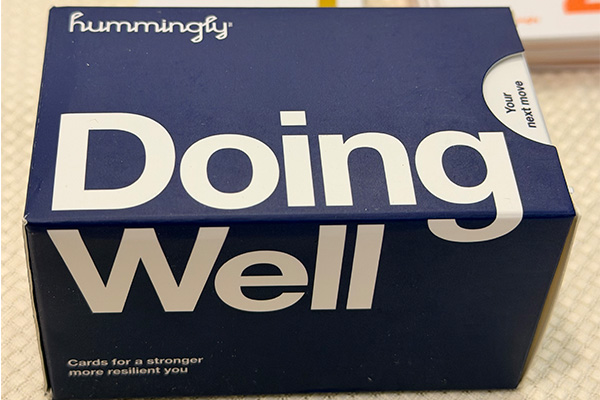
Each participant left with the Doing Well card deck, a tangible, research-informed toolkit designed to help individuals, teams, and organizations build sustainable habits of resilience. The cards cover social connection, decision-making under pressure, physical reset, emotional regulation, and team accountability, offering small, specific entry points that meet people where they are. The intention is simple: take what works for you and build from there.
Jolie frames the bigger picture with a question she poses to every room she walks into: Are you a martyr, or are you a professional?
A professional, she explains, can still care deeply, still show up with a full heart. But they build boundaries — not despite the people they serve, but because sustaining this work and doing the best for communities requires it.
The Work Behind the Work
Good360 has seen it community by community: in North Carolina after Hurricane Helene, in Los Angeles after the wildfires, and now in Kerrville. The physical needs are urgent and real, and so is everything that doesn’t show up in a damage assessment.
As Hummingly puts it, we rush to rebuild what’s visible because it’s tangible and easier to measure. But real recovery is far messier, and more human. The emotional, social, and psychological scaffolding a community needs to heal is what determines whether that community actually recovers — or just rebuilds.
Partnering with Hummingly to serve these communities is one way we’re trying to close that gap. The goods we move matter. So do the people moving them, and the people those people are trying to help.
When the supporters are supported, the whole recovery goes further.
Learn more about Hummingly’s work at hummingly.org. To learn more about Good360’s disaster response work, visit our Disaster Response and Recovery page.