 Back
Back



Wildfires don’t have to burn near your home to affect your health. During large wildfire events, smoke can travel hundreds or even thousands of miles — and for most people, the greatest danger isn’t the smoke you can see. It’s the microscopic particles you can’t.
What is wildfire smoke, and why does it travel so far?
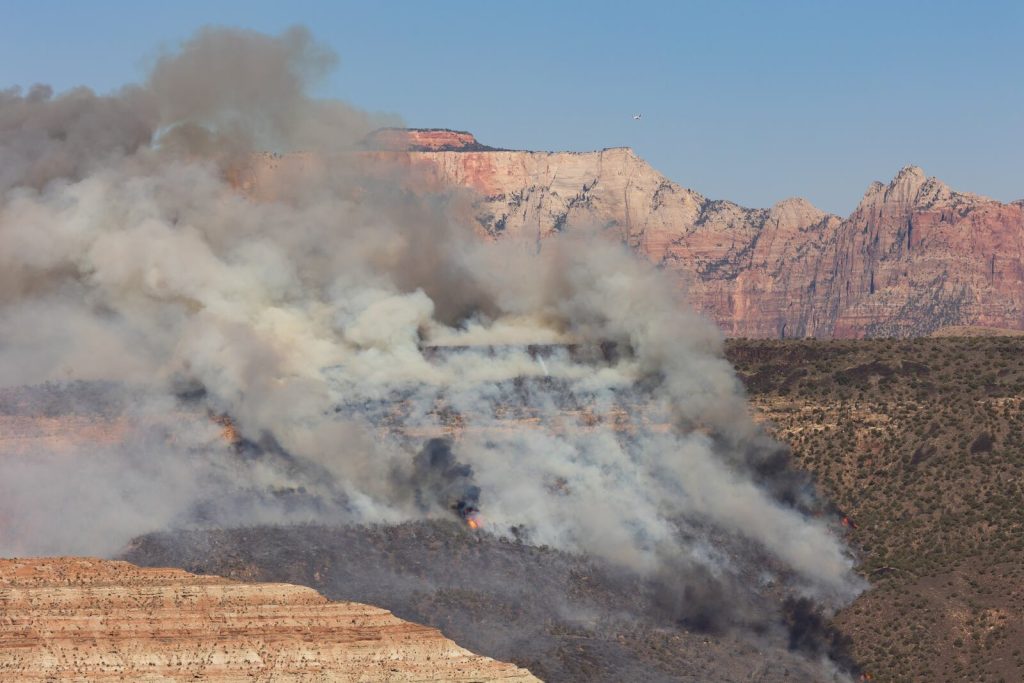
Wildfire smoke is a complex mixture of gases, water vapor, and airborne particles created when forests, grasslands, homes, vehicles, and other materials burn. The particles of greatest public health concern are PM2.5 — small enough to travel deep into the lungs. Large wildfires can loft smoke high into the atmosphere, allowing prevailing winds to carry it hundreds or even thousands of miles. You do not need to live near a wildfire to be affected by it.
Wildfire smoke is also different from ordinary air pollution: it introduces very large amounts of fine particulate matter over a short period, conditions can shift rapidly as weather changes, and smoke may carry chemicals released as structures and manufactured materials burn.
How wildfire smoke affects your health
Health effects depend on smoke concentration, duration of exposure, age, and underlying medical conditions. Even healthy adults may experience eye irritation, coughing, sore throat, headaches, fatigue, or reduced exercise tolerance.
Who is most vulnerable?
Children, older adults, pregnant people, people with asthma or COPD, people with cardiovascular disease, outdoor workers, and people without access to cleaner indoor air face higher risk during smoke events.
How to check the Air Quality Index (AQI)
Rather than relying on visible smoke or odor, monitor the Air Quality Index through AirNow.gov, which provides real-time local conditions and health recommendations. Conditions can change quickly as wind shifts, so check regularly rather than relying on a single forecast.
If local officials issue health advisories or recommend staying indoors, follow those recommendations until air quality improves.
Keeping smoke out of your home
Your home can provide meaningful protection if you limit smoky outdoor air from entering. Public health agencies generally recommend:
- Closing windows and exterior doors
- Keeping fireplace dampers closed
- Limiting trips in and out of the house
- Running central air on recirculation when available
- Replacing HVAC filters on schedule
If your home can’t be safely cooled without opening windows during dangerous heat, seek a cleaner-air location such as a library, community center, or designated clean-air shelter.
Creating a cleaner-air room
When smoke lingers for days, it may not be practical to keep your whole home smoke-free. Instead, set up one room — ideally with few windows and access to power for a portable air purifier — where household members spend most of their time. Keep pets inside with the family, and avoid activities that add indoor pollution, like smoking, candles, or frying food.
Do masks, air conditioning, and air purifiers really help?
N95 masks
Yes, when worn correctly. A properly fitted NIOSH-approved N95 respirator can significantly reduce exposure to fine smoke particles. Not all masks are equal:
| Mask type | Protects against PM2.5 |
|---|---|
| NIOSH-approved N95 | Yes |
| KN95 (reputable manufacturer) | Often, if properly fitted |
| Surgical mask | No |
| Cloth mask | No |
| Bandana or scarf | No |
An N95 filters particles but not gases like carbon monoxide or VOCs that may also be present in smoke.
Air conditioning
Usually, yes — when windows and doors stay closed, the system recirculates indoor air, and filters are clean. Some portable AC units and evaporative coolers behave differently and may pull in outdoor air, so check your manufacturer’s guidance if unsure.
HEPA air purifiers
Yes. A properly sized HEPA purifier is one of the most effective tools for reducing fine smoke particles indoors. Choose one sized for the room, run it continuously while smoke is elevated, and replace filters on schedule. Be cautious of products relying mainly on ionization or ozone generation — public health guidance favors proven mechanical HEPA filtration.
Preparing before wildfire season
Consider assembling a wildfire smoke preparedness kit with:
- Replacement HVAC filters
- A portable HEPA air purifier
- NIOSH-approved N95 respirators
- Prescription medications and inhalers
- Bottled water and shelf-stable food
- Flashlights, batteries, and a portable phone charger
- Copies of important documents
- Pet food and medications
It also helps to identify your cleaner-air room ahead of time and get familiar with local emergency alerts.
Frequently asked questions
Yes. Large wildfires can send smoke high into the atmosphere, allowing winds to carry it across states and international borders.
A properly fitted NIOSH-approved N95 respirator helps reduce exposure to fine smoke particles. Cloth masks and surgical masks do not provide the same protection.
Yes. Keep windows closed, use recirculation mode if available, and maintain clean HVAC filters.
Portable HEPA air purifiers are among the most effective tools for reducing fine smoke particles indoors.
As AQI worsens, reduce strenuous outdoor activity, since increased breathing raises smoke exposure.
Yes, pets can be affected too. Keep them indoors when possible and contact a veterinarian if respiratory symptoms develop.
Learn more about how Good360 is responding to the wildfires nationwide. [Read More →]
References
U.S. EPA. Wildfire Smoke: A Guide for Public Health Officials.
AirNow. When Smoke Is in the Air.
Centers for Disease Control and Prevention. Wildfires and Wildfire Smoke.
U.S. EPA. Air Quality Index (AQI) Basics.